
The Viksit Bharat Shiksha Adhishthan Bill, 2025 is a Lok Sabha bill, introduced as Bill No. 194 of 2025, that seeks to replace India’s existing higher-education regulators — the University Grants Commission (UGC), the All India Council for Technical Education (AICTE), and the National Council for Teacher Education (NCTE) — with a single umbrella body supported by three specialised councils. It was introduced by the Union Education Minister, Dharmendra Pradhan, and is designed to simplify what the government views as an over-regulated, multi-agency system governing universities and colleges across the country.
Core Idea Behind the Bill
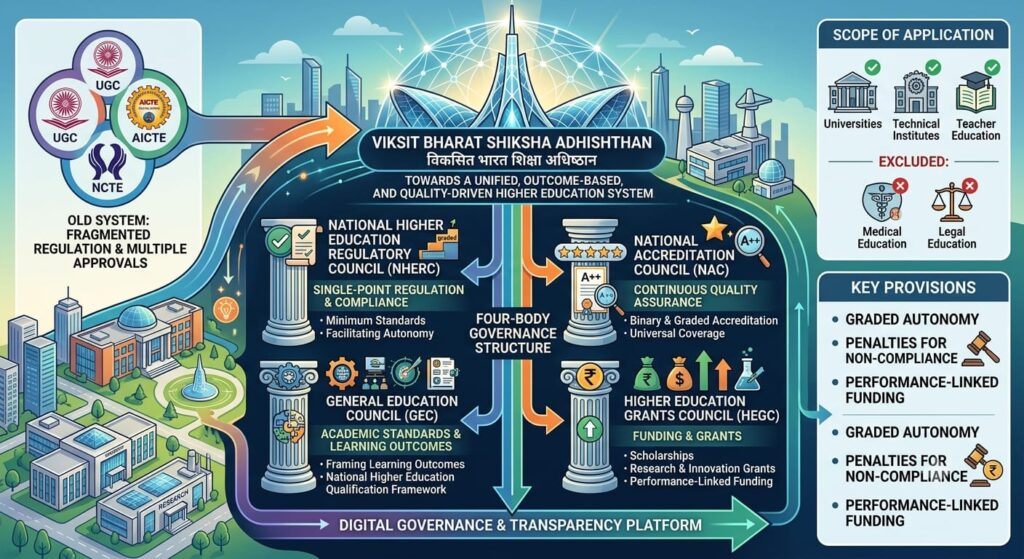
The Statement of Objects and Reasons attached to the bill explains that India’s higher-education sector has expanded to more than a thousand universities and over sixty thousand institutions enrolling more than four crore students. Over the years, multiple separate regulators created duplicated approval processes and inspection requirements, resulting in what the bill calls ‘over-regulation’ of the sector. Drawing from the vision of the National Education Policy 2020, the bill proposes a ‘light but tight’ regulatory model — meaning fewer but more effective controls built around public self-disclosure by institutions, rather than continuous government inspection and multiple approvals.
The Four-Body Structure
At the apex sits the Viksit Bharat Shiksha Adhishthan, referred to in the bill as ‘the Commission’. It is a body of up to twelve members, including a Chairperson, the ex-officio presidents of the three councils below it, a representative from the Ministry of Education, two academicians from state higher education institutions, and five independent experts. The Commission’s role is strategic rather than regulatory — it is meant to give high-level direction on multidisciplinary growth of institutions, position India as a global education destination, promote the integration of Indian knowledge systems and languages, and ensure coordination among the three councils rather than directly overseeing individual institutions.
Beneath the Commission are three independent verticals, each carrying a distinct mandate:
- Viksit Bharat Shiksha Viniyaman Parishad (Regulatory Council): Functions as the common regulator for higher education. It pushes institutions toward graded autonomy once they achieve accreditation, mandates public disclosure of finances and academic outcomes on a dedicated portal, handles student grievances, and is required to take corrective action within sixty days of any dishonest disclosure or impropriety by an institution.
- Viksit Bharat Shiksha Gunvatta Parishad (Accreditation Council): Builds and administers the accreditation framework for institutions. It empanels and monitors accrediting agencies and can recommend action where accreditation-related violations occur.
- Viksit Bharat Shiksha Manak Parishad (Standards Council): Sets academic standards across the system — defining learning outcomes, the nomenclature of degrees, diplomas and certificates, credit-transfer norms, and minimum requirements for setting up new institutions.
This three-way separation follows the NEP 2020 principle that funding, standard-setting, regulation and accreditation should not be concentrated in a single authority — a structural departure from the UGC model, where one body largely performed most of these roles together.
Who the Bill Covers
The bill applies broadly to institutions of national importance, all central and state universities, deemed universities, and colleges affiliated with them, as well as institutions currently regulated under laws such as the Architects Act and the AICTE Act. It notably excludes professional regulators such as the Bar Council of India, the National Medical Commission, and the Pharmacy Council, whose independent licensing powers over their respective professions remain untouched. The Council of Architecture is given a unique dual status — it continues to regulate architectural practice on its own, while also sitting inside the Standards Council to help shape academic norms for architecture education.
Governance, Penalties and Finance
Members of the Commission and the Councils are to be appointed through a Search-cum-Selection Committee, and they are required to make annual declarations of any conflicts of interest. A two-year cooling-off restriction applies before they can take up related employment after leaving office. The Regulatory Council is empowered to impose penalties for violations, following a prescribed adjudication process, and any sums collected are credited to the Commission’s fund — though the bill is explicit that penalties must never come at the financial cost of enrolled students. Financing for the entire structure comes through grants approved by Parliament into a dedicated Viksit Bharat Shiksha Adhishthan Fund, and the bill notes that the overall budget is not expected to exceed what the UGC, AICTE and NCTE currently receive combined.
Transition From the Old System
The bill repeals the UGC Act, 1956, the AICTE Act, 1987, and the NCTE Act, 1993, and dissolves the three bodies created under them once the new structure is formally notified. Existing staff, assets, and any pending legal proceedings of these bodies are transferred to the new Commission or Councils, and the current standards set by the UGC, AICTE and NCTE remain valid until replaced under the new Act, so there is no sudden regulatory gap. The Central Government also retains a three-year window after commencement to issue orders resolving any practical implementation difficulties, and in exceptional circumstances, it may supersede the Commission or any Council for up to six months if it fails to discharge its duties properly.