Abstract
The expectation from the literate population is to make informed decisions. Considering India’s landscape, there are few states that come to the forefront of literacy, and one of the most spoken, or maybe over-advertised, ones is Kerala! Historically, Kerala elects the Communist Party-led LDF or the Congress-led UDF every alternative term, and very rarely does the trend go for a consecutive term for the incumbent government. Few states in India show similar voting behaviour, and Kerala is the discussion point here because of the claim of being the highest literate state, along with Meghalaya and others.
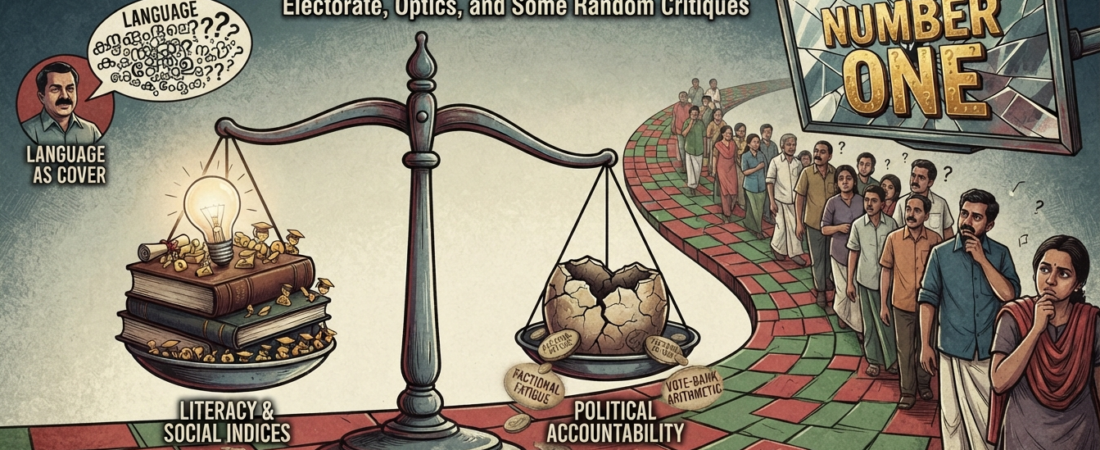
If literacy really shaped judgement the way Kerala likes to claim, this voting pattern would be the place to see it — and that is the test this piece runs on. This piece asks a narrower question than ‘Is Kerala’s literacy real?’: does the electorate’s own behaviour support the idea that literacy translates into wiser political judgement, or is the alternating-government pattern better explained by factional fatigue and vote-bank arithmetic than by informed accountability voting?
This particular piece is based on the experience of the people and largely from the conversation held with Keralites rather than a well-researched, data-backed article. Treat it as a freewheeling opinion with a critical take on the optics without substance of Kerala’s literacy.
The Self-Image
There are many stories. If you grow up in Kerala—depending on the place—and if you are outside Kerala, then what you hear about the state and the stories evolve. But one common thing by design or otherwise fed to people in Kerala is that they are better than the rest of India. This feels primarily like a state finding pride in its social status or any achievements it can proudly show, deservedly. But when this argument is made on every parameter and sociopolitical issue, that will lead to soul-searching and introspection. Contrary to that, Keralites started buying into their own advertisement; predominantly in the age of social media influence, the narrative of being the best-travelled spread faster than the Swifts.
This made me look into the political psyche of the population, because if a sensible society behaves like a literate one at all, then in a democracy, what other measurements are better than their electoral decision? For all practical purposes, elections and the way they vote will decide the state and its future in every aspect, including the parameters of education and literacy, which apparently they claim to be better on par with some of the foreign universities in the West.
But the alternating-government pattern cuts both ways as evidence. It can be read as anti-incumbency driven by informed accountability — voters punishing non-performance regardless of party, which is arguably a sign of a discerning electorate, not an undiscerning one. Or it can be read as the product of entrenched factional and religious-bloc arithmetic that simply rotates on a fixed cycle, with ‘change’ being cosmetic rather than a verdict on governance. The essay’s implicit claim — that this pattern undercuts Kerala’s literacy mythology — needs one of these readings argued for, not assumed. The stronger case for the second reading is what follows.
Optics vs. Substance
The reality is Kerala subtly managed to fix their religious, caste, and organisational votes without the outsiders knowing and pretended to be a socially inclusive and all-accepting society. To be fair to the state, the discrimination based on the aforementioned factors is very low, and there is a decent level of control on that. But the issue here is claiming Kerala as number one irrespective of facts and figures. The former minister in charge of industry claimed that Kerala has the highest number of industries in India and that the ex-chief minister and road transport minister preached about roads that the developed nations do not have and that European policymakers come to Kerala to learn the best practices in administration and governance; instead, what we see is a delegation from Kerala going to Scandinavian countries to learn about preventing floods.
Language as Cover
Clearly the politicians take advantage of the language of Malayalam and ensure it doesn’t attract the national media, and if someone goes for a national media debate, either in English or Hindi, their articulation capacity will make Shakespeare look like a toddler! The next thing is the politician is going to be meme or troll material until they get someone else, and trust me, they find it faster than an average bullet train in Japan. And the obvious cover-up is Mr Shashi Tharoor is also a Malayali; see him speak! Interestingly, the list of avid speakers begins and ends with that one name. It would not be a problem if Kerala politicians would not be flaunting the number-one state tag and then stammering like a stuck gramophone.
The English-fluency deflection is itself evidence of the same pattern: it substitutes a proxy (one telegenic exception) for the substance in question (whether the political class the state actually elects is accountable to scrutiny), which is exactly the move being made with ‘number one’ more broadly.
Conclusion
None of this means Kerala’s literacy is fake or that its social indicators aren’t real achievements — they are. What’s fake is the leap from ‘we can read’ to ‘we govern and vote wisely’, a leap the state’s own politicians lean on precisely because no one, voter or journalist, asks them to defend it.
My suggestion to Kerala politicians is very simple. There is no need for any hard work if you still want to be genuinely number one. Just change the definition of ‘number one’ with a line: wherever Kerala is getting placed is called ‘number’, irrespective of the sequence or position.
Good Analysis. Even I had the same opinion.
Very nice 👍
Wow! Such a beautiful piece!